Mattress Materials & Construction
Dunlop and Talalay Latex: How Processing Shapes Mattress Feel
Latex can feel buoyant, gently contouring, or distinctly firm—but the word “latex” alone cannot tell you how a mattress will sleep. Dunlop and Talalay are two manufacturing processes that shape the material’s structure. Understanding the difference offers a useful starting point, while the finished mattress’s layers, firmness, and design tell the fuller story.
A practical guide to latex processing, mattress construction, and what to look for when comparing natural latex and organic latex mattresses.
First, what does “Dunlop” or “Talalay” mean?
Dunlop and Talalay refer to ways of making latex foam. They are not separate materials in the way that latex and memory foam are, and neither name guarantees that a mattress will be comfortable, durable, or right for a particular sleeper. Both processes turn liquid latex into a resilient foam, but the steps used to fill, expand, and set the material differ. Those steps can influence the finished foam’s density and feel.
That distinction matters when reading a mattress description. A process name describes part of the material’s manufacture; it does not describe the whole mattress. The thickness and firmness of each layer, the cover and quilting, and the support beneath the latex all contribute to how a bed feels in use.
It is helpful to think of the process as one ingredient in a larger recipe. A mattress made with Dunlop latex can feel soft or firm depending on its formulation and placement in the build. A Talalay layer can likewise be used in different firmnesses and configurations. A label is a clue, not a verdict.
How Dunlop latex is made
In the Dunlop process, liquid latex is poured into a mold and then heated to set into foam. The material is generally allowed to settle during this process. As a result, Dunlop latex is often described as having a denser or more substantial feel than Talalay latex. That description is a broad tendency, not a reliable promise about the feel of every product: formulation, firmness, and the surrounding mattress layers still make a significant difference.
The qualities commonly associated with Dunlop—resilience, a stable feel, and a sense of solidity—can make it a practical choice for support layers. But it is not limited to the base of a mattress. Depending on how it is made and used, Dunlop latex can also form a comfort layer closer to the sleep surface. The key is to look at the specification for that particular layer rather than assume its role from the process name.
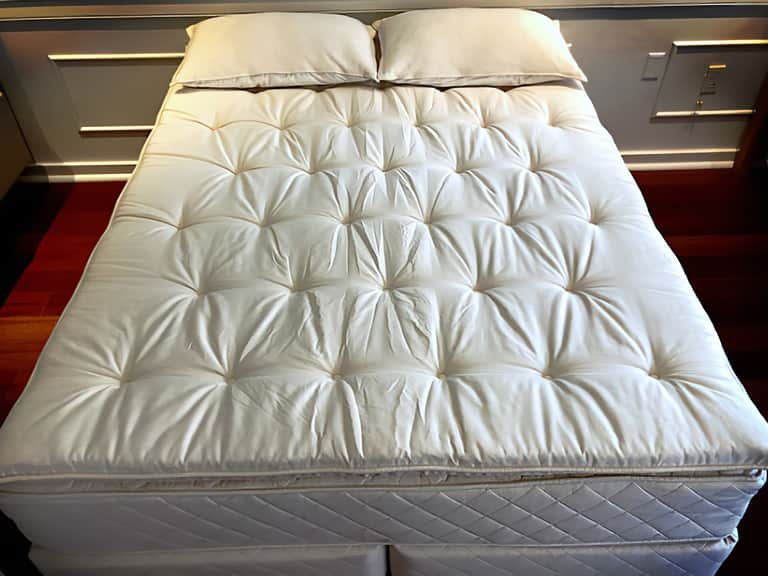
For example, the Naturally Organic Hudson Luxe Latex Mattress uses organic Dunlop latex in more than one part of its construction: a firmer core is paired with a medium latex layer and a plush topper containing latex and wool. This illustrates why a mattress’s complete configuration matters. Its feel is shaped not only by the type of latex but by how layers of different firmness and materials work together.
When evaluating Dunlop, look for the manufacturer’s stated firmness, thickness, and position in the mattress. If a listing says “Dunlop latex” but offers little information about the layer or overall construction, the process name alone will not tell you whether the mattress will feel suitable.
How Talalay latex is made
Talalay production adds steps to the molding process. The latex mixture is placed into a mold that is not filled completely; the mold is then sealed, and a vacuum expands the mixture to fill the space. The material is frozen before it is heated to set. The resulting foam is often associated with a lighter, more open structure and a springy, buoyant sensation.
Those descriptions can help orient a comparison, but they should not be mistaken for a guarantee. “Lighter” or “more buoyant” is not the same as “softer,” and softness is not the same as pressure relief. A Talalay layer may be produced in different firmnesses, and its feel will depend on thickness and on what sits above and below it. A mattress with a thin, firmer Talalay layer may feel quite different from one with a thicker, softer layer.
Talalay latex is often used in comfort layers, where a responsive surface can provide some contouring without the slow, enveloping sensation associated with certain other foams. Yet construction choices vary among manufacturers. Rather than expecting every Talalay mattress to feel alike, consider how a particular mattress describes its layer design and how that design aligns with your preferences.
Dunlop vs. Talalay at a glance
The following comparison summarizes common descriptions of the two processes. It is a starting point for questions, not a substitute for the specifications of an individual mattress.
| Consideration | Dunlop latex | Talalay latex |
|---|---|---|
| General process | Latex is poured into a mold and heated to set. | Latex is placed in a partially filled mold, expanded under vacuum, frozen, and then heated to set. |
| Commonly described feel | Often characterized as denser or more substantial. | Often characterized as lighter, springier, or more buoyant. |
| Potential mattress role | May be used in support layers, comfort layers, or both. | May be used in comfort layers or other positions, depending on the design. |
| What the name cannot establish | Exact firmness, comfort, support, durability, or suitability for a sleeper. | Exact firmness, comfort, support, durability, or suitability for a sleeper. |
| What else to compare | Layer thickness, firmness, cover, certifications, and full construction. | Layer thickness, firmness, cover, certifications, and full construction. |
Both types are resilient foams, but the difference between them is best understood as one aspect of material construction—not as a ranking. A well-designed mattress may use either process successfully. The more useful question is whether the mattress’s full design provides a feel and support profile that suits the person who will sleep on it.
Why the finished design matters more than the process label
A mattress is a system of layers, not a single block of material. A top layer influences the initial sensation when you lie down; deeper layers contribute to how the mattress supports your body. The overall result also depends on the cover, quilting, and foundation. Two mattresses made with the same type of latex can feel markedly different if their layer arrangements and firmness levels are not alike.
Thickness is one detail to check. A thin comfort layer may make a modest change to the surface feel, while a thicker layer can have a more noticeable effect. Firmness is another: manufacturers may offer latex in different firmness levels, and the scale or terminology used to describe those levels can vary. “Medium” from one maker is not necessarily identical to “medium” from another.
Layer order matters as well. A softer layer over a firmer support core may create a more cushioned first impression while keeping the mattress from feeling uniformly soft. Several layers can be combined to balance surface comfort and deeper support. Some mattresses use natural materials such as wool and cotton alongside latex, and those materials can change the surface texture, cushioning, and temperature experience.
Even the cover should not be treated as a decorative afterthought. Quilting or padding can add another layer between the sleeper and the latex, subtly changing how directly the foam’s responsiveness is felt. A removable cover may simplify access to internal layers, but care instructions and warranty terms can differ. Read them before choosing, especially if you expect to rotate or adjust components.
A mattress description that clearly identifies layer materials, thicknesses, firmness options, and construction gives a more meaningful picture than a headline that simply says “Dunlop” or “Talalay.” When those details are missing, ask the manufacturer or retailer for clarification rather than drawing conclusions from a single word.
Natural latex and organic latex: terms worth distinguishing
“Natural latex” generally refers to latex made from rubber-tree sap, though the exact composition and any other ingredients depend on the product. A mattress can contain natural latex without every part of the mattress being natural. Covers, adhesives, quilting, fire barriers, and other components may use different materials. For a fuller picture, check the material list for the complete product rather than relying on a broad label.
“Organic” is a separate claim that should be supported by relevant certification and clear information about what is certified. A certified organic latex component does not automatically mean every layer, accessory, or part of the mattress has the same certification. Look at the scope of the certification, the named material, and the certifying standard. If a product is described as an organic latex mattress, the details should help you understand what that phrase applies to.
For shoppers comparing natural latex organic mattresses, useful questions include: What is the latex made from? Which parts are certified, and to what standard? Are there other materials in the comfort layers or cover? How is the mattress assembled? Are care instructions, construction details, and warranty conditions readily available?
Certifications and material descriptions answer different questions from firmness and comfort. A certification can help substantiate a material or production claim, but it cannot tell you whether a mattress feels right for your body or sleep preferences. Keep those questions separate as you assess a product: first establish what it is made of, then consider how it is built, and finally evaluate whether its feel and support meet your needs.
How to compare latex mattresses thoughtfully
Shopping becomes more manageable when you compare mattresses by the same set of criteria. Instead of starting with a process label and trying to infer the rest, use the label as one line in a broader checklist.
- Identify each layer. Find out whether a mattress contains Dunlop latex, Talalay latex, or a combination, and note where each material sits in the build.
- Check thickness and firmness. A layer’s depth and stated firmness help explain its likely role, though product descriptions and firmness scales can differ.
- Review the complete material list. Consider the cover, quilting, wool or cotton components, and any other materials—not just the latex core.
- Look for relevant certification details. Confirm which material is certified and what the certification covers.
- Read the trial, return, and warranty terms. These policies affect the practical experience of choosing a mattress, but do not assume that every policy applies in the same way to every model.
- Check care and foundation requirements. Some latex mattresses have specific support, ventilation, or cleaning instructions. Follow the manufacturer’s guidance.
- Use your own comfort preferences as the final filter. Consider whether you prefer a more buoyant surface, a firmer feel, or more cushioning, while remembering that the process name alone cannot predict the match.
If you can try a mattress in person, pay attention to the sensation of settling into it and changing positions. If you are comparing online, seek detailed construction information and use any available trial period in accordance with its terms. Give yourself time to assess the mattress on its intended foundation, with the bedding you normally use.
A note on firmness, body shape, and sleep position
Comfort is personal. Body shape, weight distribution, habitual sleep position, and individual sensitivity to pressure can all affect how a mattress feels. A firmness label is a convenient shorthand, but it cannot account for every sleeper or every build. Nor does a generalization about Dunlop or Talalay substitute for assessing the actual mattress.
Someone who prefers a responsive, lively surface may want to investigate how a particular latex layer feels, while a person seeking a more cushioned surface may focus on the thickness and softness of the upper layers. Those are starting questions, not universal rules. A mattress’s underlying support and overall construction remain important regardless of the sleeper’s preferred surface sensation.
When two people share a bed, their preferences may differ. In that situation, pay close attention to whether a mattress offers separate firmness choices or a configuration designed to accommodate different needs. Some builds are customizable; others are not. Confirm the details rather than assuming that a layered latex design can be adjusted after purchase.
Common assumptions to leave behind
“Dunlop is always firm.” Dunlop is often described as dense, but the finished layer’s firmness depends on its formulation and specification. The material name is not a complete firmness rating.
“Talalay is always soft.” A lighter, buoyant feel is commonly associated with Talalay, but the process does not make every Talalay layer soft. Look for the firmness and design details of the actual mattress.
“One process is automatically higher quality.” Quality depends on materials, manufacturing, construction, and how the product performs over time. Neither process name alone establishes a quality ranking.
“Organic means the whole mattress is certified.” Certification may apply to particular materials or components. Check the documentation and scope rather than assuming every part of a product has the same status.
“The latex type predicts the whole sleep experience.” The entire assembly—including layer thickness, firmness, cover, and foundation—shapes the final feel. A headline material is only one part of that picture.
The bottom line
Dunlop and Talalay describe two methods for processing latex. Dunlop is often associated with a denser, more substantial feel; Talalay is often associated with a lighter, more buoyant one. These broad comparisons can help you understand product language, but they are not guarantees about firmness, comfort, performance, or suitability.
When exploring natural latex or organic latex mattresses, give equal attention to the details behind the label: the materials used, which components are certified, the construction and thickness of each layer, the firmness offered, and the care and warranty information. A clear description of the finished design is more useful than relying on the process name as a shortcut.
The most informed comparison is not simply Dunlop versus Talalay. It is an examination of how the latex was processed, where it appears in the mattress, what surrounds it, and how the whole build is intended to feel. With those details in view, you can weigh the choices with greater confidence—and without expecting one material label to answer every question.